• If you ask me, why I am a Catholic Christian, my answer would be like the one of Saint Augustine’s: “I won’t be a Christian if not for the Catholic Church”.

  • “And to the angel of the church in Smyrna write: This is what the first and the last, who was dead, and has come to life, says:” Revelation 2:8

  • The one baptizing names over the one being baptized the name of “the Lord Jesus Christ,” later expanded to the name of the Father, the Son, and the Holy Spirit

  • Go ye and make disciples of all nations, and baptize them in the name of the Father, and of the Son, and of the Holy Ghost.

  • Go ye and make Disciples of all nations, and baptize them in the name of the Father, and of the Son, and of the Holy Ghost.

  • In this post I will be citing from St. Augustine’s Tractates on the Gospel of John where he discusses our Lord’s statement to the Father being the only true God, and where he also explains our Lord’s words in v. 5 as referring to God having predestined the glorification and exaltation of Christ’s humanity from before…

  • Paedocommunion 🍷 Paedocommunion is the practice of giving the Eucharist to baptized children before they reach the age of reason. What Paedocommunion Is The term comes from the Greek paido (child) and communio (communion). It refers to the reception of the Holy Eucharist by children, typically those under seven years old or before First Holy…

  • The following is excerpted from this post:Luther on Luke 2 – Saint John’s Lutheran Church. Then there are some who express opinions concerning how this birth took place, claiming Mary was delivered of her child while she was praying, in great joy, before she became aware of it, without any pains. I do not condemn…

  • Arians like JWS Admit that the Reason why God in the OT referred to Himself in the plural is because He was speaking with his Divine Son! Astonishingly, there are certain anti-Trinitarian groups, such as the Jehovah’s Witnesses, which readily admit that the reason why God refers to himself in the plural in the following…

  • Answering anti-Trinitarians objections

  • Answering anti-Trinitarians objections.

  • Forty years before the coming of the Messiah, son of David, whose name is Menakim, son of Ammiel, Necamiah, son of Cusiel, a man from Ephraim, son of Joseph, will come.

  • Just as THE HOLY ONE, BLESSED BE HE, is humble, so is His Shechinah humble.

  • The following citation comes from St. Augustine’s On the Trinity, Book 1.. The blessed Augustine quotes Philippians 3:3 to prove that the Holy Spirit is given latreuo, which is the worship given to God alone. 13. Similar evidence has been collected also concerning the Holy Spirit, of which those who have discussed the subject before ourselves have most fully…

  • An analysis of how the NT expands upon an OT monotheistic text In order to include Jesus within God’s unique identity

  • Question: The Bible, specifically Paul, says there is only one God and that is the Father (cf. 1 Corinthians 8:6; Ephesians 4:6; 1 Timothy 2:5). Since Trinitarians believe that Jesus is not the Father, this means that Jesus is not God. Answer: Paul is no more denying the fact that the Lord Jesus is God…

  • “Your throne is established from of old; You are from everlasting.” Psalm 93:2

  • The following citation is from Luther’s On the Conception of the Mother of God, AD 1527: “The conception, namely the infusion of the soul, is believed to have taken place gently and blessedly, without original sin coming upon her; so that in the infusion of the soul she was also at the same time purified from…

  • The following quotation is courtesy of William Albrecht. It is from a letter that Martin Luther wrote in the final years of his life, and provides further confirmation that this leading reformer held to the perpetual virginity of Mary. Luther even claims that this doctrine is based on inspired Scripture, and not merely on sacred…

  • There are four places in the inspired OT writings where the one true God employs plural pronouns to describe himself: “Then God said, ‘Let US make man in OUR image, after OUR likeness; and let them have dominion over the fish of the sea, and over the birds of the air, and over the cattle,…

  • The thread running through nearly every conversion story is the same: authority, the Eucharist, and Church history. When pastors begin to read the early Church Fathers with honest hearts, they consistently find themselves walking toward Rome.

  • Where it is stated (of the Messianic King in Ps. 72:5): LET THEM FEAR YOU AS LONG AS THE SUN ENDURES AND AS LONG AS THE MOON, A GENERATION AND GENERATIONS.

  • Who has ever heard of such a thing? Who has ever seen such a thing? In the beginning, the intention of Ha-Kadosh Barukh Hu was to divert Israel to the desert for six months, from Nisan to Tishrei. But when He contemplated the suffering of the Messiah during all those years, immediately, suddenly, He will…

  • In the year 268 AD, a provincial council was convened at Antioch, Syria where the Apostles of the risen Lord often frequented and where believers were first called Christians: “Then departed Barnabas to Tarsus, for to seek Saul: and when he had found him, he brought him unto Antioch. And it came to pass, that a…

  • The following is adapted from this post: Creed of the Antioch Council of 325. All emphasis will be mine. 8. Ἔστιν οὖν ἡ πίστις, ἣ προετέθη ὑπ’ ἀνδρῶν, πνευματικῶν καὶ οὺς αὖθις οὐ δίκαιον νομίφειν κατὰ σάρκα τῆν ἢ νοεῖν, ἀλλὰ ἐν πνεύματι ταῖς τῶν θεοπνεύστων βιβλίων ἁγίαις γραφαῖς συνησκῆσθαι, ἥδε· πιστεύειν εἰς ἕνα θεὸν πατέρα παντοκράτορα,…

  • In this article I will present more evidence in support of Mary’s perpetual virginity by showing how the Lord God made her womb the holy of holies for Christ to dwell in all his fullness. THE HIGH PRIEST AND THE HOLY OF HOLIES The God-breathed Scriptures affirm that the high priest alone was authorized to…

  • Jesus forgives sins, only God forgives sins, that means Jesus is God!

  • In this post I am going to employ the interpretive method, which unitarians apply to Scripture to undermine Christ’s Deity, against them. I will show how their approach in attacking Christ’s divinity can be used to prove that the Father cannot be the true God, since only the Son is.     UNITARIAN PROOFTEXTS Anti-Trinitarians often…

  • In this post I will cite from a few of the early Christian writers who viewed Mary as the new Eve, just as Christ was the new Adam, who through her obedience undid what Eve’s disobedience did to creation. JUSTIN MARTYR Chapter 100. In what sense Christ is [called] Jacob, and Israel, and Son of…

  • Luke records the words the angel Gabriel uttered to the holy Mother of Christ as he came to announce the glorious and blessed Incarnation of our Lord:   “And he came to her and said, ‘Hail (Chaire), full of grace (kecharitomene), the Lord is with you!’” Luke 1:28   The word Chaire appears four other…

  • In this post I will present evidence from the epistle of Jude showing that this inspired author believed that Jesus is YHWH God Almighty who became flesh.   THE GOD OF THE SHEMA The inspired letter begins with Jude describing himself as the servant/slave of the risen Jesus and then goes on to identify Christ…

  • ungodly persons who turn the grace of our God into sensuality and who deny our ONLY Master and Lord, Jesus Christ (ton MONON despoten kai kyrion hemon ‘Iesoun Christon).” Jude 1:4

  • And there is one Lord, Jesus Christ (heis Kyrios ‘Iesous Christos), by whom everything exists, and by whom we ourselves are alive.” 1 Corinthians 8:6

  • “Yahweh, your Redeemer, and he who formed you from the womb says: “I am Yahweh, who makes all things; who ALONE stretches out the heavens; who spreads out the earth BY MYSELF;” Isaiah 44:24

  • “Hear, O Israel! Yahweh is our God, Yahweh is one!” Deuteronomy 6:4

  • The Pope’s authority over other bishops is real, direct, and juridical, not merely honorary, because it belongs to the very constitution of the Church willed by Christ. At the same time, it is ordered to communion and the safeguarding of the faith, not to arbitrary domination. 1) The foundation: why the Pope can discipline bishops…

  • The tactic that schismatics started using was, (Pope of Rome, Roman Catholic etc.), and that’s misleading!

  • Prophet or tool of the devil?

  • In this post I will be referencing the late Protestant scholar J. B. Lightfoot’s monumental work on the early church’s view of the blessed Mother’s virginity. All bold and capital emphasis will be mine. Lightfoot did a careful, painstaking analysis of the early Christians writings, examining the extant sources from the first century and up…

  • At the Council of Ephesus (431 AD), the blessed St. Cyril of Alexandria uttered a litany of praise to the blessed Mother of our God Incarnate in honor of her being the holy and pure God-bearer. Here’s what this holy servant of Christ wrote: “Mary, Mother of God, we salute you. Precious vessel, worthy of…

  • The statements cited here are taken from For the Life of the World: Toward A Social Ethos of the Orthodox Church, published by Holy Cross Orthodox Press in 2020. The document can be accessed at the Greek Orthodox Archdiocese of America website: Social Ethos Document. Here is the PDF Version. The readers will see that…

  • The Catholic Church says in ccc841 that Muslims (profess) to worship the God of Abraham and together with us worship one God, creator and merciful judge etc. The Catholic Church doesn’t say things like the east are saying. Orthodox say that us and Muslims worship the same God.

  • The Catholic Church says in ccc841 that Muslims (profess) to worship the God of Abraham and together with us worship one God, creator and merciful judge etc. The Catholic Church doesn’t say things like the east are saying. Orthodox say that us and Muslims worship the same God.

  • “But you, Bethlehem Ephrathah, Though you are little among the thousands of Judah, Yet out of you shall come forth to Me The One to be Ruler in Israel, Whose goings forth are from of old (miqqedem), From everlasting (olam).” Micah 5:2

  • “The blessed Peter, the chosen, the preeminent, the first among the disciples, for whom alone with himself the Savior paid the tribute [Matt. 17:27], quickly g.asped and understood their meaning. And what does he say? ‘Behold, we have left all and have followed you’ [Matt. 19:27; Mark 10:28]” [A.D. 200]).

  • Christianity Trinity Church History Gospel Jesus Christ

  • After the martyrdom of Paul and of Peter, Linus was the first to obtain the episcopate of the church at Rome. Paul mentions him, when writing to Timothy from Rome

  • How, then, can it be asserted that there once was a time when He was not the Son?

  • Origen affirms that Jesus Christ is the uncreated firstborn Son of God

  • The following excerpts are from Origen’s Commentary on the Gospel of John.

  • In this post, I will be citing the exegesis of Protestant expositors in regards to the language employed by Luke in recording the annunciation of, and subsequent reactions to, Jesus’ virginal conception. It has long been noted that Luke describes this miraculous event in a way that is strikingly reminiscent to the manner the Hebrew…

  • The information posted here is uploaded from the following article: The original papyrus fragment.   In 1917, a stunning treasure came to the John Rylands Library in Manchester, England. It was a piece of papyrus, Egyptian in origin.   On this fragment, in Greek, is inscribed a hymn to Mary, called in Latin Sub Tuum Praesidium,…

  • The very last writing of St. Augustine was the Opus Imperfectum contra Julianum, literally, the “Unfinished Work Against Julian.” The name itself tells the whole story. What was it? Augustine wrote this work in the closing years of a life occupied with three great controversies, Manichaeism, Donatism, and Pelagianism the last of which ended with…

  • WHAT Although there were always a few dissenters, for the first one thousand years of the Church there was a broad consensus among the Fathers on all the basic tenets of the faith, from Baptism to the Eucharist to the role of Tradition. As the most respected pastors and theologians of their day, the opinion…

  • A Response to Ibn Anwar’s Anti-Trinitarian “Examination of Mark 12:29-34” One of the scribes came and heard them arguing, and recognizing that He had answered them well, asked Him, “What commandment is the foremost of all?” 29 Jesus answered, “The foremost is, ‘HEAR, O ISRAEL! THE LORD OUR GOD IS ONE LORD; 30 AND YOU…

  • In this relatively short, post I will show from the Jehovah’s Witnesses’ own perverted Bible translation that the one true Creator God is Triune. I will be using the New World Translation of the Holy Scriptures (Study Edition). According to the Hebrew Bible, Jehovah created and gives life to all creation all by himself, without…

  • Arian polemicist Greg Stafford has made it a chief aim of his mission to do all he can to pervert the explicit biblical witness to the Son’s uncreated, eternal nature and existence. Yet in his misguided zeal he often makes claims that end up refuting him since his points actually prove that Christ is not…

  • The Greek word for “sent” in Romans 10:15 is apostalosin — and for St. Paul, unless one is sent with apostolic authority, one has no authority in the Church.

  • In this post I will cite the works of three intellectual and spiritual giants of the Faith to show how they interpreted Genesis 1:26-27, particularly verse, where God uses plural pronouns when speaking of making man in the image and likeness of God. The readers will see that these magnificent men of the Church took…

  • The teaching of the ancient Churches that Mary was made perfectly holy and kept absolutely pure is based on the necessary conclusion of what the Scriptures teach in respect to the holiness and purity of God. For instance, the Holy Bible is explicitly clear that nothing unclean and impure can dwell with God: “If I…

  • Since Jesus is God Incarnate! The inspired Scriptures teach that Yahweh alone is able to save people from their sins. The sacred writings further attest that Yahweh does so for his own name’s sake, and not for the sake of another, “You are My witnesses, says the Lord, and My servant whom I have chosen…

  • The first and most well-known command reads, “I am the LORD your God who rescued you from the land of Egypt, the place of your slavery. You must not have any other god but me.” (Exodus 20:2-3)

  • Sunday 03 May 2026 Why May is Called the Month of Mary 👑 May is dedicated to Mary because of her unique place in God’s plan and the Church’s ancient practice of honoring her with particular devotion during the spring season. The Historical RootsThe formal dedication of May to Mary emerged gradually over centuries, though…

  • Question: I can understand how God can hear and respond to millions of prayers said at the exact same time, because He is omniscient. But how can the Blessed Mother and the Saints, like St. Faustina, deal with it? They are human, like us, but in heaven rather than on earth. The blessed Mother especially,…

  • In this post I will quote what the official documents of the Catholic Church teach in respect to the world’s religions and how salvation is to be obtained. I begin with what Catechism of the Catholic Church says: The Church and non-Christians 839 “Those who have not yet received the Gospel are related to the People of…

  • Who, being in very nature God (hos en morphe theou hyperchon)

  • The following excerpt is taken from the monumental work titled The Incarnate Christ and His Critics: A Biblical Defense, authored by Robert M. Bowman Jr. & J. Ed Komoszewski, published by Kregel Academic, Grand Rapids, MI, in 2024, Part 3: The Name of Jesus: Jesus’ Divine Names, 24. Jesus as “God” in the Rest of the New…

  • The Old Testament prophet Malachi announced by the Holy Spirit (cf. 2 Pet. 1:20-21) that a time would come when all throughout the world the Gentiles would offer to God a pure sacrifice: “A son honors his father, and a servant his master. If then I am a father, where is my honor? And if…

  • In this post I will cite from both Martin Luther and John Calvin admitting that the Eucharist was viewed to be Christ’s propitiatory sacrifice by the Church universally, with Calvin virtually admitting that this has been the belief from time immemorial. Calvin even dared to claim that this was due to the work of Satan…

  • In this segment I will show how this renowned Bishop of Alexandria affirmed doctrines which directly contradict the beliefs of Calvinists, since Cyril taught the perpetual virginity of the blessed Mother, water baptismal regeneration, and that the eucharist is the body and blood of Christ. All emphasis will be mine. MARY’S PERPETUAL VIRGINITY 4. CHRIST…

  • I will be quoting the very church fathers, writers, theologians and/or apologists that Calvinists will often reference in order to mislead folks into thinking that these early Christians held to beliefs similar to their own. I will prove that these Calvinists are being inconsistent and/or dishonest in doing so since these very early authorities taught…

  • In this post I will use the case of Judas Iscariot to refute the Calvinistic doctrine of T.U.L.I.P.(1)by showing that the God-breathed Scriptures emphatically teach that Christ chose him for the express purpose of saving him, even though the Lord knew that he was a devil whom Satan would tempt to betray God’s uniquely begotten…

  • John Calvin saw a tension between his belief in God having freely, sovereignly decreed to save only the elect whom he would effectual bring to saving faith in Christ with those statements in Scripture that affirm God desiring, wanting, willing and calling all mankind to salvation in Christ. In order to resolve this contradiction with…

  • Table of Contents It is time again to show how the beliefs of some of the early church’s greatest scholars, theologians, apologists, philosophers, martyrs etc., directly conflict with Protestantism in general, and with Calvinism in particular.   In this segment, I will show how the views of both Augustine and John the Damascene contradict the…

  • Table of Contents 1 Chapter 5.— Against the Title of the Epistle of Manichæus In the following extract Augustine shows how the Gospels’ reliability rests on the authority of the Catholic Church and to, therefore, attack the Church is to undermine the veracity of the Gospels themselves. Here is what he wrote in refuting of…

  • The oldest extant written mention of the term Catholic, as applied to the Church, is found in one of the letters of the holy martyr St. Ignatius, who was a disciple of the Apostles and the Bishop of Rome: Chapter 8. Let nothing be done without the bishop See that you all follow the bishop, even…

  • Monepiscopacy, also called monarchical episcopate, refers to a single bishop chosen to preside and rule over the church with a college of presbyters and deacons. The evidence shows that this was an early and widespread practice of the universal church. In fact, a strong case can be made that this structure was already in place…

  • The following is taken from St. John Chrysostom’s Homily on St. Ignatius. All emphasis will be mine. 4. And I will speak of a fourth crown, arising for us out of this episcopate. What then is this? The fact that he was entrusted with our own native city. For it is a laborious thing indeed to have…

  • I will be quoting from the late Dr. Robert A. Morey’s The Trinity: Evidence and Issues, published by World Bible Publishers, Inc., Iowa Falls, IA, in 1996, Part IV: The New Testament Evidence, Chapter 17. God The Son. All emphasis will be mine.   The Blood of God   Be on guard for yourselves and…

  • I will be quoting from the late Dr. Robert A. Morey’s The Trinity: Evidence and Issues, published by World Bible Publishers, Inc., Iowa Falls, IA, in 1996, Part IV: The New Testament Evidence, Chapter 17. God The Son. All emphasis will be mine.   The Theophanies   We have already seen that in Old Testament…

  • The Council of Chalcedon is important in the history of Christianity, because it helped harmonize Saint Cyril of Alexandria’s Christology with the historical Christology of the West. These Christologies were identical during their day. The actual decree of Chalcedon that delineates the council’s Christology specifically quotes and parallels Cyril’s Christology and at one point, even his deposed…

  • Saint Cyril of Alexandria’s Christology is not terribly complicated. He taught that the person of God the Word assumed human essence, so that after this assumption (the incarnation) He had both a divine and human essence. Sometimes essence is called “substance” as it is in the Latin tradition and other times it is called “nature”…

  • 2 nd Century AD St. Clement of Alexandria (150-215 AD) “The believer through discipline divests himself of his passions and passes to the mansion better than the former one, passing through torments with repentance for post-baptismal sins. Although these punishments cease after purification, God’s righteousness allows for temporary suffering during expiation.” (Patres Groeci. IX, col.…

  • The following is taken from St. Irenaeus’ Adversus haereses, Book III. All emphasis will be mine. Chapter 3 A refutation of the heretics, from the fact that, in the various Churches, a perpetual succession of bishops was kept up. 1. It is within the power of all, therefore, in every Church, who may wish to see the truth,…

  • The following excerpt is taken from Francis Dvornik, Byzantine missions among the Slavs. SS. Constantine-Cyril and Methodius (F. Dvornik, Byzantine missions among the Slavs – 6), pp. 189-192. The citations deal with the letter of Pope St. Stephen (Latin – Stephanus V, died September 14, 891) where he mentions that the Roman Church is the seat…

  • In this post I will be citing from the works of St. Epiphanius in respect to the eternal procession of the Holy Spirit from the Father and/through the Son. All emphasis will be mine.   44,3 I myself, therefore, do not worship anything that is inferior to the essence of God himself, since it is…

  • In this post I will be citing from the works of St. Cyril of Alexandria where this blessed saint spoke of the Spirit’s essential/natural procession from both the Father and the Son. All emphasis will be mine.   1.  That the Holy Spirit is naturally of God, and in the Son, and through Him and…

  • In this post I will share a few quotes from St. Gregory in respect to the Filioque, e.g., the Holy Spirit’s eternal procession from the Father by/through the Son. All emphasis will be mine.     Indeed, it would be a lengthy task to set out in detail from the Scriptures those constructions which are inexactly expressed,…

  • The extract is taken from St. Gregory Nazianzus’ Orations where he discusses the monarchy of the Father in respect to the Trinity. All emphasis will be mine. Oration 29    The Third Theological Oration.   On the Son.   I. This then is what might be said to cut short our opponents’ readiness to argue…

  • This comes from St. Gregory’s Oration 25. All emphasis will be mine. Define our piety by teaching the knowledge of: One God, unbegotten, the Father; and One begotten Lord, his Son, referred to as “God” when he is mentioned separately, but “Lord” when he is named together with the Father—the first on account of the [divine]…

  • What a rich and important topic. St. Irenaeus of Lyons stands as one of the most powerful early witnesses to the primacy of Rome, and his testimony deserves to be understood in full — both its weight and its context. 🏛️ St. Irenaeus of Lyons on the Papacy Who Was Irenaeus? St. Irenaeus (c. 130–202…

  • Free Grace Theology (FGT) — associated with figures like Zane Hodges and the Grace Evangelical Society claims to honor the Bible, but when held up to the full light of Scripture and Sacred Tradition, it falls short in several serious ways, and we’re going to prove it how it contradicts the Bible also! What Free…

  • This excerpt is taken from St. Athanasius who claims that the language adopted by Nicaea to describe the Son’s essential equality with the Father isn’t new but quite ancient, going back to at least 130 years earlier. Athanasius exposed the Arian heretics by appealing to an unbroken chain of Apostolic succession of Bishops to prove…

  • David Kimchi, also known as RaDaK, was a medieval rabbinic commentator and philosopher who lived from 1160–1235 AD. In this post I will quote from his commentary in regards to a few OT texts that are either Messianic or have a direct bearing on Christian exegesis of OT verses, such as Psalm 2:12. Radak on…

  • I share the following article on St. Maximus the Confessor from CATHOLIC ENCYCLOPEDIA: St. Maximus of Constantinople. St. Maximus of Constantinople Known as the Theologian and as Maximus Confessor, born at Constantinople about 580; died in exile 13 August, 662. He is one of the chief names in the Monothelite controversy one of the chief doctors of the theology of the Incarnation and of ascetic mysticism, and…

  • In this post I will be quoting from Catholic Commentary on Sacred Scripture: The Gospel of John, by Francis Martin and William M. Wright IV, published by BakerAcademic, a division of Baker Publishing Group, Grand Rapids, Michigan, and published in 2015. All emphasis will be mine. Authorship The Gospel does not explicitly name its author,…

  • Another Arian Bites the Dust According to John’s Gospel, the prophet Isaiah saw Jesus Christ in his prehuman existence as YHWH of Hosts seated on his heavenly throne: “Jesus replied, ‘The light is with you for a little while longer. Walk while you have the light, so that the darkness may not overtake you. The one who…

  • The land of Illyricum

  • In this post I will be looking at two OT texts, which the early Christians saw as foreshadowing Christ’s crucifixion. These early writers employed these particular verses as prophesying or prefiguring Christ’s death on a cross. First Prophecy I begin with the following reference from the Jeremiah: “and I am as a lamb or a…

  • In this article I will quote the relevant verses from both the Old and New Testaments where Israel is either said to be Sodom and Gomorrah, or even worse than them. I will further show how God also warns that Israel’s punishment will be much more severe and worse than that which he inflicted upon…

  • In this post I will be looking at two OT texts, which the early Christians saw as foreshadowing Christ’s crucifixion. These early writers employed these particular verses as prophesying or prefiguring Christ’s death on a cross.     First Prophecy   I begin with the following reference from the Jeremiah:   “and I am as…

James E. Snapp

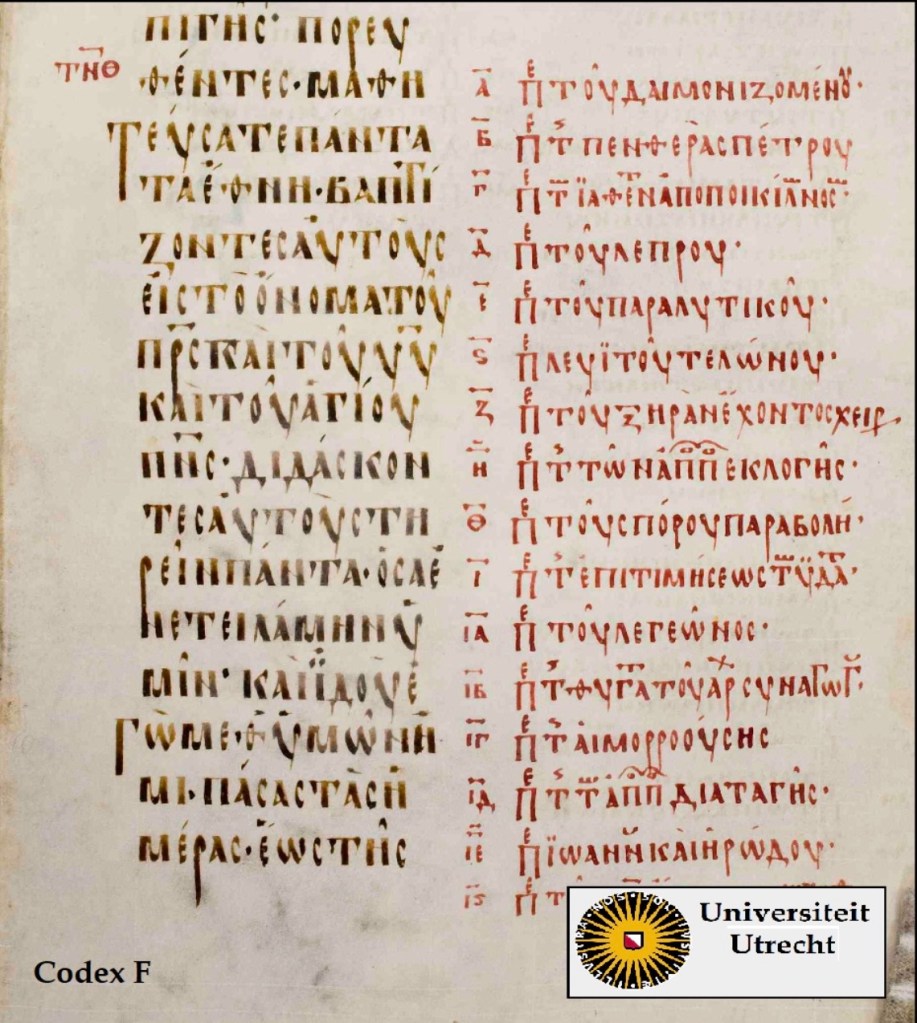
Mattheww 28:19-20a in Codex F, beside part of the chapter-list for Mark.

“This is perhaps a case of late interpolation.” That was liberal scholar Rudolph Bultmann’s opinion of the words “in the name of the Father, and of the Son, and of the Holy Spirit” in Matthew 28:19.

Earlier, in 1902, Frederick C. Conybeare – who might be considered the Bart Ehrman of his day – claimed in a detailed essay in The Hibbert Journal (and in 1901 in Zeitschrift fur Neutestamentlich Wissenschaft, pp. 275-288) that he had found patristic evidence against the genuineness of this phrase “so weighty that in [the] future the most conservative of divines will shrink from resting on it any dogmatic fabric at all.”

At this very moment, there are some in the Oneness Pentecostal denomination who similarly regard the threefold formula “in the name of the Father, and of the Son, and of the Holy Spirit” as an early scribal corruption. The theological impetus for this position is not hard to find: throughout the book of Acts, Luke reports that the early Christians baptized “in the name of Jesus Christ” (2:38), or “in the name of the Lord Jesus” (8:16), or “in the name of the Lord” (10:48); the use of a threefold declaration at baptism is never mentioned by Luke.

Some Oneness Pentecostals have attempted to resolve this apparent discrepancy by taking a theological step that is not far from – and perhaps indistinguishable from – the early heresy of modalism: they baptize without such a threefold formula, and insist that the name “Jesus” is the name of the Father, and the name of the Son, and the name of the Holy Spirit. Others, while theologically greatly distanced from Bultmann and Conybeare, share with them a rejection of the authority of Matthew 28:19 on the grounds that the phrase “in the name of the Father, and of the Son, and of the Holy Spirit” is not authentic. Some Islamic groups similarly reject the genuineness of this phrase.

Usually when a reading has the support of every Greek manuscript in existence in which a passage is extant – as is the case here at the end of Matthew – there is no text-critical issue and it is accepted as genuine, as a matter of course. Even Bart Ehrman – who has proposed (like Gordon Fee before him) that First Corinthians 14:34-35, despite having enormous manuscript support, contains a lengthy interpolation – recently wrote, “It is usually thought that Matt. 28:19-20 is referring to the practice in Matthew’s own community, some 50 years after Jesus’ death, not to the words Jesus himself actually spoke.” (Readers of such comments should understand that when Ehrman employs phrases such as “It is usually thought,” he means, “It is usually thought among my colleagues who deny supernatural events in general.”) Regarding those who, instead, claim to reject the phrase on text-critical grounds: what are their grounds?

Their go-to source is Eusebius of Caesarea, the influential and not-entirely-orthodox historian of the early 300s, best-known for his composition Ecclesiastical History. As Conybeare documented, Eusebius utilized Matthew 28:19seventeen times in ways that indicate that his text of the verse read πορευθέντες μαθητεύσατε πάντα τὰ ἔθνη ἐν τῷ ὀνόματί μου, that is, “As you go, make disciples of all nations in My name.” Part of Conybeare’s argument that this reading should be given exceptional weight is that Eusebius was stationed in Caesarea, where in the previous generation Origen had enlarged the library with his own manuscripts; thus, it may be reasonably thought that among the manuscripts accessible to Eusebius in the early 300s were some copies from the early 200s, earlier than any existing copies of Matthew 28:19.

Conybeare’s quotations from Eusebius may have initially appeared to justify his confident assertions, but he was quickly answered by J. R. Wilkinson in The Hibbert Journal in 1902, in the second part of an article titled, Mr. Conybeare’s Textual Theories (beginning on p. 96 of the journal issued in October of 1902, and on p. 571 of the digitally archived copy). Wilkinson granted that Eusebius used a text in which “in My name” was in the first part of Matthew 28:19, referring to disciple-making, but he reasoned that this does not imply that “in the name of the Father, and of the Son, and of the Holy Spirit” was absent from the second part of the verse, referring to baptism. The textual critic Frederick Chase also wrote a response against Conybeare’s approach in 1905 in the Journal of Theological Studies (beginning on p. 481).

A comprehensive, and decisive, answer against Conybeare’s proposal appeared in 1923 in Bernard Henry Cuneo’s published dissertation, The Lord’s Command to Baptise: An Historico-Critical Investigation With Special Reference to the Works of Eusebius of Caesarea. Cuneo systematically scrutinized Conybeare’s quotations from Eusebius, one by one, along with other quotations, and showed that Eusebius, like some other patristic writers, tended to limit his quotations to the segments of Scripture that were relevant to the topic that he was discussing at a given point.

For example, Cuneo examples Eusebius’ statement in Ecclesiastical History 3:5 and considers the development of Eusebius’ argument in which the quotation occurs: Eusebius quoted Matthew 28:19a, not to say something about baptism, but to confirm a parenthetical point; in the course of describing the Roman siege of Jerusalem, he writes:

“. . . because the Jews continued to persecute His disciples, by stoning Stephen, beheading James the brother of John, and putting to death James the bishop of Jerusalem; and because they afflicted the other apostles so severely that they fled from Palestine and began to preach the Gospel to all the nations – imbued with the power of Christ who had said to them, “Going, make disciples of all the nations in my name” – and when all the Christians had left Jerusalem and fled to Pella, then the divine vengeance visited upon Jerusalem the crimes of which that city had been guilty against Christ and his disciples.”

In Demonstration of the Gospel 1:6, Eusebius wrote, “Our Lord and Savior, Jesus the Son of God, said to His disciples after His resurrection, ‘Go and make disciples of all the nations,’ and added, ‘Teaching them to observe all things whatsoever I have commanded you.’” Here we do not see the middle of verse 19 because it is not pertinent to Eusebius’ present subject, whereas the beginning and end are pertinent.

Although this frugality may seem strange nowadays – that is, modern readers may understandably ask, “Why not just quote the whole verse?” – we ought to remember that nobody quoted from the New Testament in terms of chapter-and-verse divisions as we know them until the mid-1500s. Quoting only what needed to be quoted in order to support a particular point was common in ancient times; Eusebius shows the same tendency toward brevity in his quotations of Matthew 11:27, 16:18, etc.

Cuneo’s cumulative case is so effective that I recommend it to everyone who might encounter echoes of Conybeare’s argument; The Lord’s Command to Baptise is available online as a free download at Google Books. Archive.org also has a copy. Cuneo reminds readers about other patristic evidence in favor of the inclusion of the words “in the name of the Father, and of the Son, and of the Holy Spirit.” For example:

  • Didache, chapter 7 (early 100s): “Concerning baptism, baptize thus: having first rehearsed all these things, baptize in the name of the Father and of the Son and of the Holy Spirit, in running water. But if you have no running water, baptize in other water, and if you cannot in cold, then in warm. But if you have neither, pour water three times on the head ‘in the name of the Father, Son and Holy Ghost.’”
  • Irenaeus, Against Heresies, Book 3, part 17 (c. 180): concluding a series of proof-texts supporting his contention that it was not a Christ-persona, but the Holy Spirit, who descended upon Jesus: “He said to them, Go and teach all nations, baptizing them in the name of the Father, and of the Son, and of the Holy Spirit.”
  • Tertullian, De Baptismo, ch. 13 (c. 200): “The law of baptism was enjoined and its ritual prescribed. ‘Go,’ He says, ‘teach the nations, baptizing them in the name of Father and Son and Holy Spirit.’ The addition to this law of the regulation: ‘Except one be born again of water and spirit, he shall not enter into the kingdom of heaven,’ bound faith to the necessity of baptism. Consequently from that time all believers were baptized.”
  • Tertullian, De Praescriptione Haereticorumch. 20 (c. 200): “He commanded the eleven others, on His departure to the Father, to go and teach all nations, who were to be baptized into the Father, and into the Son, and into the Holy Ghost.”
  • Hippolytus, Contra Noetum, ch. 14 (early 200s): “The Father’s Word, therefore, knowing the economy (i.e., disposition) and the will of the Father, that is, that the Father seeks to be worshipped in no other way than this, gave this charge to the disciples after He rose from the dead: ‘Go and teach all nations, baptizing them in the name of the Father, and of the Son, and of the Holy Spirit.’ And by this He showed that whosoever omitted any one of these, failed in glorifying God perfectly.”
  • Acts of Thomas 9:4 (early 200s): “And the apostle, having taken oil, and poured it over their head, and salved and anointed them, began to say, ‘Come, holy name of Christ, which is above every name; come, power of the Most High . . . come, Holy Spirit, and purify their reins and heart, and seal them in the name of Father, and Son, and Holy Spirit.’”

Participants at the Seventh Council of Carthage (257), which was focused on the subject of baptism, included

Lucius of Castra Galbae, who quoted Christ’s words from Matthew 28:18-19, including “Go and teach all nations, baptizing them in the name of the Father, and of the Son, and of the Holy Spirit.”

Munnulus of Girba, who stated, “our Lord says, “Go ye and baptize the nations, in the name of the Father, of the Son, and of the Holy Spirit.”

Euchratius of Thence, who said that Jesus Christ, teaching the apostles with His own mouth, “has entirely completed our faith, and the grace of baptism, and the rule of the ecclesiastical law, saying, “Go ye and teach all nations, baptizing them in the name of the Father, and of the Son, and of the Holy Spirit.”

Vincentius of Thibaris, who, in addition to alluding to Mark 16:15-18, said that the Lord said, in another place, “Go ye and teach the nations, baptizing them in the name of the Father, of the Son, and of the Holy Spirit.”

Cuneo also spent several pages showing that Eusebius of Caesarea was indeed the author of Against Marcellus (336/337) and A Letter to the Caesareans Concerning the Council of Nicea. In the second composition, Eusebius introduces and repeats his own creed, which, he says, was read at the Council of Nicea in the presence of Emperor Constantine:

“As we have received from the bishops who preceded us, and in our first catechisms, and when we received the holy laver [i.e., at baptism], and as we have learned from the divine Scriptures, and as we believed and taught in the presbytery, and in the episcopate itself, so believing also at the time present, we report to you our faith, and it is this:

“We believe in One God, the Father Almighty, the Maker of all things visible and invisible. And in One Lord Jesus Christ, the Word of God, God from God, Light from Light, Life from Life, Son Only-begotten, first-born of every creature, before all the ages, begotten from the Father, by Whom also all things were made; Who for our salvation was made flesh, and lived among men, and suffered, and rose again the third day, and ascended to the Father, and will come again in glory to judge the quick and dead. And we believe also in One Holy Ghost.”

This is followed by an addition affirmation:

“Believing each of these to be and to exist, the Father truly Father, and the Son truly Son, and the Holy Ghost truly Holy Ghost, as also our Lord, sending forth His disciples for the preaching, said, ‘Go teach all nations, baptizing them in the name of the Father and of the Son, and of the Holy Ghost.’ Concerning whom we confidently affirm that so we hold, and so we think, and so we have held previously, and we maintain this faith unto the death, condemning every godless heresy.” 

In another composition, the rarely cited Syriac Theophania, Eusebius of Caesarea made a full quotation of Matthew 28:17-20 in Book IV, chapter 8:

“After His resurrection from the dead, all of them [i.e., the eleven apostles], being together as they had been commanded, went to Galilee, as He had said to them. But, when they saw Him, some worshipped Him, but others doubted. But He drew near to them, spoke with them, and said, ‘All power in heaven and earth, is given to me of my Father. Go ye and make disciples of all nations, and baptize them in the name of the Father, and of the Son, and of the Holy Ghost. And teach them to observe all that I have commanded you. And, behold! I am with you always even to the end of the world.’ Observe now, in these things, the consideration and caution evinced by the disciples . . . .”

(In the same composition, which its translator, Samuel Lee, translated from a Syriac manuscript which had been obtained by Henry Tattam at the Monastery of the Blessed Virgin in the Nitrian Desert – a manuscript which Lee assigned to a period no later than the 400s – Eusebius explicitly quotes Matthew 28:19a with “in My name” as part of the text, saying in Book 5 chapter 46, “It was not that He commanded them, simply and indiscriminately, to go and make disciples of all nations, but with this excellent addition which He delivered, specifically, ‘in My name.’”)

In addition to demolishing Conybeare’s case against the phrase “in the name of the Father, and of the Son, and of the Holy Spirit,” Cuneo offered an explanation for the presence of the words “in My name” in Eusebius’ text of Matthew 28:19a: it is a simple harmonization drawn from Luke 24:47.

This introduces a fresh subject: the abundance of alterations, harmonistic or otherwise, that are clustered in the Gospels’ accounts of Jesus’ post-resurrection appearances. These passages were among the most-used parts of the Gospels in early church-services, and were thus especially vulnerable to early liturgical influence. Here are a few examples:

  • In the Peshitta version of Matthew, Matthew 28:18 features an insertion drawn from John 20:21; after the usual words of the verse, the Peshitta adds, “As the Father sent Me, so also I send you.” (Codex Θ also has this feature.)

● In the Alexandrian text of Luke 24:42, there is no mention of honeycomb. The words και απο μελσσίου κηριου could have been accidentally skipped due to early scribal inattentiveness; και follows κηριου in the next sentence. But another possibility is that these words – supported by Tertullian, the vast majority of Greek manuscripts, the Vulgate, the Armenian version, etc. – were removed intentionally to avoid incorporating honey into annual Easter-time worship-services.
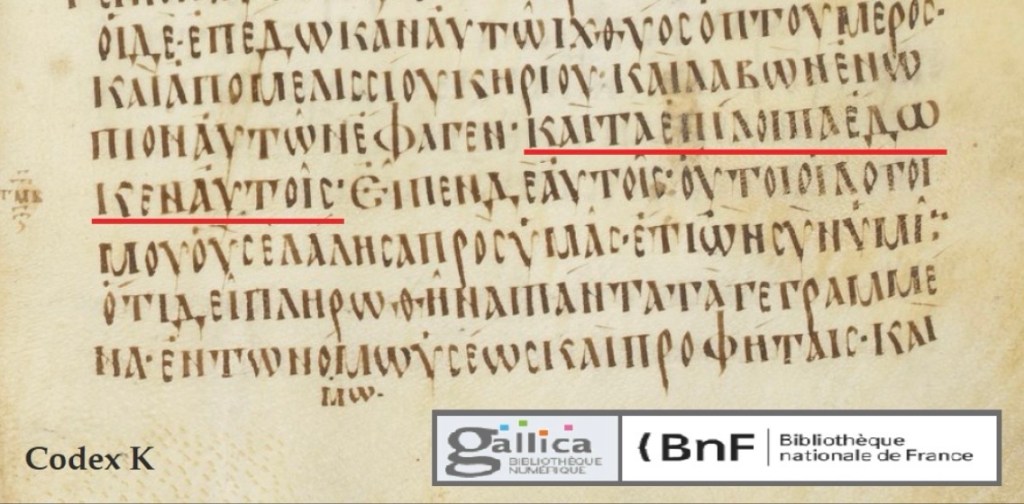
Extra words appear in the text of
Luke 24:43 in Codex K.

● In Luke 24:43, after the usual statement that Jesus “took and ate in their presence,” several significant manuscripts – including K, Θ, Π*, and members of f13, as well as the Vulgate and, according to Tregelles, the Curetonian Syriac and the Armenian and Ethiopic versions, also say, “and gave the rest to them.” (Θ does not include “and.”) This phrase may have been added when and where the passage had been interpreted somewhat mystically – the fish in the narrative being seen as congruent to the presence of Christ, ΙΧΘΥΣ – and when this point was reached in the Scripture-reading in the worship-service, the celebration of the Lord’s Supper commenced.

● In Luke 24:36, after Jesus’ appearance in the midst of the disciples, He says to them, “Peace to you!” In a small number of Greek manuscripts (including uncials G and P), and in the Vulgate, Jesus says a bit more; He goes on to say, “It is I; do not be afraid.” These extra words – drawn from John 6:20 – are supported, according to the UBS apparatus, by the Vulgate, the Peshitta, the Harklean Syriac, the Armenian version, and by Ambrose and Augustine (in Contra Felicem Manichaeum). In addition, in Codex W, “It is I; do not be afraid” appears before “Peace to you.”

All these witnesses may echo early Easter-time liturgical arrangements of the blended-together Gospel-accounts. An early attempt to remove the intruding words appears to have gone too far; in several Old Latin manuscripts and in Codex Bezae, the entire phrase – “and said to them, “Peace to you” – is missing. (This is one of the “Western Non-interpolations” which appear in Luke 24.) Another possibility is that the phrase was skipped by accident.

The worship-services of the early churches had a detectable impact upon the text of the New Testament. But the impact of the text of the New Testament upon the early churches was far greater. As far as the use of the words, “in the name of the Father, and of the Son, and of the Holy Spirit,” are concerned, there was one reason for the early Christians to use these words: they were attributed to Christ in every copy of the Gospel of Matthew.