James E. Snapp
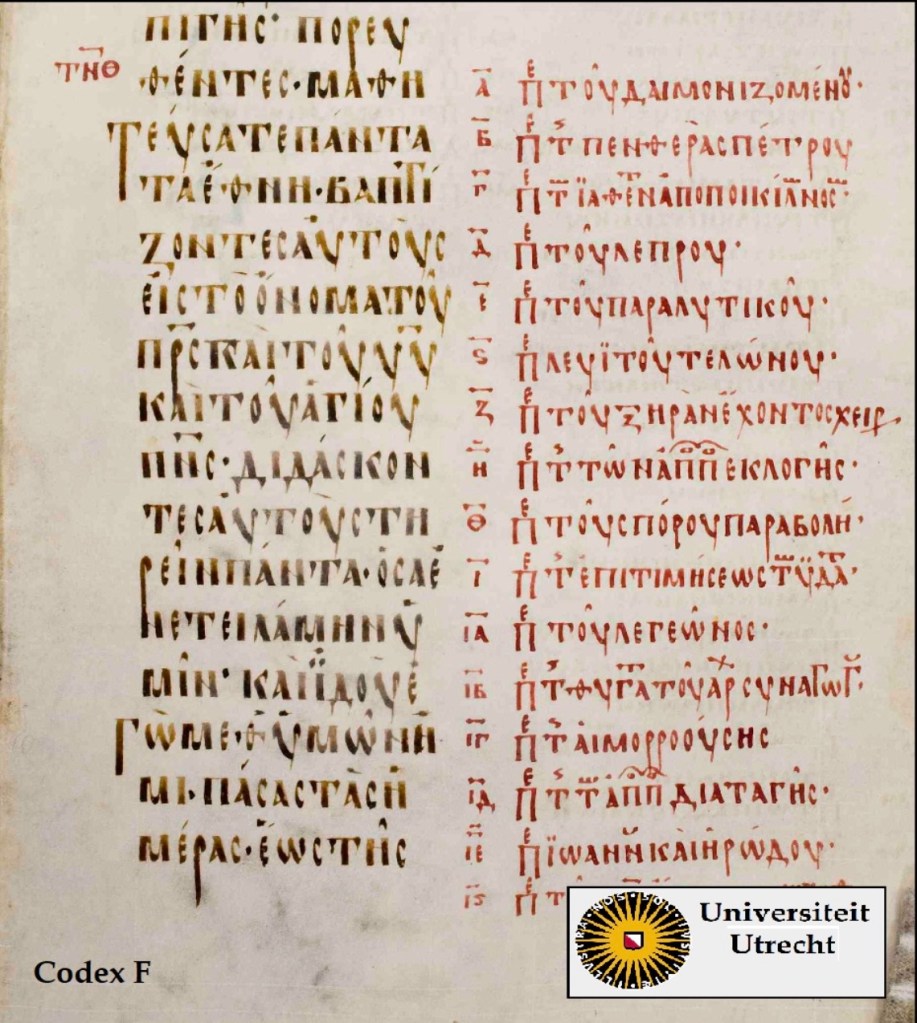
Mattheww 28:19-20a in Codex F, beside part of the chapter-list for Mark.
“This is perhaps a case of late interpolation.” That was liberal scholar Rudolph Bultmann’s opinion of the words “in the name of the Father, and of the Son, and of the Holy Spirit” in Matthew 28:19.
Earlier, in 1902, Frederick C. Conybeare – who might be considered the Bart Ehrman of his day – claimed in a detailed essay in The Hibbert Journal (and in 1901 in Zeitschrift fur Neutestamentlich Wissenschaft, pp. 275-288) that he had found patristic evidence against the genuineness of this phrase “so weighty that in [the] future the most conservative of divines will shrink from resting on it any dogmatic fabric at all.”
At this very moment, there are some in the Oneness Pentecostal denomination who similarly regard the threefold formula “in the name of the Father, and of the Son, and of the Holy Spirit” as an early scribal corruption. The theological impetus for this position is not hard to find: throughout the book of Acts, Luke reports that the early Christians baptized “in the name of Jesus Christ” (2:38), or “in the name of the Lord Jesus” (8:16), or “in the name of the Lord” (10:48); the use of a threefold declaration at baptism is never mentioned by Luke.
Some Oneness Pentecostals have attempted to resolve this apparent discrepancy by taking a theological step that is not far from – and perhaps indistinguishable from – the early heresy of modalism: they baptize without such a threefold formula, and insist that the name “Jesus” is the name of the Father, and the name of the Son, and the name of the Holy Spirit. Others, while theologically greatly distanced from Bultmann and Conybeare, share with them a rejection of the authority of Matthew 28:19 on the grounds that the phrase “in the name of the Father, and of the Son, and of the Holy Spirit” is not authentic. Some Islamic groups similarly reject the genuineness of this phrase.
Usually when a reading has the support of every Greek manuscript in existence in which a passage is extant – as is the case here at the end of Matthew – there is no text-critical issue and it is accepted as genuine, as a matter of course. Even Bart Ehrman – who has proposed (like Gordon Fee before him) that First Corinthians 14:34-35, despite having enormous manuscript support, contains a lengthy interpolation – recently wrote, “It is usually thought that Matt. 28:19-20 is referring to the practice in Matthew’s own community, some 50 years after Jesus’ death, not to the words Jesus himself actually spoke.” (Readers of such comments should understand that when Ehrman employs phrases such as “It is usually thought,” he means, “It is usually thought among my colleagues who deny supernatural events in general.”) Regarding those who, instead, claim to reject the phrase on text-critical grounds: what are their grounds?
Their go-to source is Eusebius of Caesarea, the influential and not-entirely-orthodox historian of the early 300s, best-known for his composition Ecclesiastical History. As Conybeare documented, Eusebius utilized Matthew 28:19seventeen times in ways that indicate that his text of the verse read πορευθέντες μαθητεύσατε πάντα τὰ ἔθνη ἐν τῷ ὀνόματί μου, that is, “As you go, make disciples of all nations in My name.” Part of Conybeare’s argument that this reading should be given exceptional weight is that Eusebius was stationed in Caesarea, where in the previous generation Origen had enlarged the library with his own manuscripts; thus, it may be reasonably thought that among the manuscripts accessible to Eusebius in the early 300s were some copies from the early 200s, earlier than any existing copies of Matthew 28:19.
Conybeare’s quotations from Eusebius may have initially appeared to justify his confident assertions, but he was quickly answered by J. R. Wilkinson in The Hibbert Journal in 1902, in the second part of an article titled, Mr. Conybeare’s Textual Theories (beginning on p. 96 of the journal issued in October of 1902, and on p. 571 of the digitally archived copy). Wilkinson granted that Eusebius used a text in which “in My name” was in the first part of Matthew 28:19, referring to disciple-making, but he reasoned that this does not imply that “in the name of the Father, and of the Son, and of the Holy Spirit” was absent from the second part of the verse, referring to baptism. The textual critic Frederick Chase also wrote a response against Conybeare’s approach in 1905 in the Journal of Theological Studies (beginning on p. 481).
A comprehensive, and decisive, answer against Conybeare’s proposal appeared in 1923 in Bernard Henry Cuneo’s published dissertation, The Lord’s Command to Baptise: An Historico-Critical Investigation With Special Reference to the Works of Eusebius of Caesarea. Cuneo systematically scrutinized Conybeare’s quotations from Eusebius, one by one, along with other quotations, and showed that Eusebius, like some other patristic writers, tended to limit his quotations to the segments of Scripture that were relevant to the topic that he was discussing at a given point.
For example, Cuneo examples Eusebius’ statement in Ecclesiastical History 3:5 and considers the development of Eusebius’ argument in which the quotation occurs: Eusebius quoted Matthew 28:19a, not to say something about baptism, but to confirm a parenthetical point; in the course of describing the Roman siege of Jerusalem, he writes:
“. . . because the Jews continued to persecute His disciples, by stoning Stephen, beheading James the brother of John, and putting to death James the bishop of Jerusalem; and because they afflicted the other apostles so severely that they fled from Palestine and began to preach the Gospel to all the nations – imbued with the power of Christ who had said to them, “Going, make disciples of all the nations in my name” – and when all the Christians had left Jerusalem and fled to Pella, then the divine vengeance visited upon Jerusalem the crimes of which that city had been guilty against Christ and his disciples.”
In Demonstration of the Gospel 1:6, Eusebius wrote, “Our Lord and Savior, Jesus the Son of God, said to His disciples after His resurrection, ‘Go and make disciples of all the nations,’ and added, ‘Teaching them to observe all things whatsoever I have commanded you.’” Here we do not see the middle of verse 19 because it is not pertinent to Eusebius’ present subject, whereas the beginning and end are pertinent.
Although this frugality may seem strange nowadays – that is, modern readers may understandably ask, “Why not just quote the whole verse?” – we ought to remember that nobody quoted from the New Testament in terms of chapter-and-verse divisions as we know them until the mid-1500s. Quoting only what needed to be quoted in order to support a particular point was common in ancient times; Eusebius shows the same tendency toward brevity in his quotations of Matthew 11:27, 16:18, etc.
Cuneo’s cumulative case is so effective that I recommend it to everyone who might encounter echoes of Conybeare’s argument; The Lord’s Command to Baptise is available online as a free download at Google Books. Archive.org also has a copy. Cuneo reminds readers about other patristic evidence in favor of the inclusion of the words “in the name of the Father, and of the Son, and of the Holy Spirit.” For example:
- Didache, chapter 7 (early 100s): “Concerning baptism, baptize thus: having first rehearsed all these things, baptize in the name of the Father and of the Son and of the Holy Spirit, in running water. But if you have no running water, baptize in other water, and if you cannot in cold, then in warm. But if you have neither, pour water three times on the head ‘in the name of the Father, Son and Holy Ghost.’”
- Irenaeus, Against Heresies, Book 3, part 17 (c. 180): concluding a series of proof-texts supporting his contention that it was not a Christ-persona, but the Holy Spirit, who descended upon Jesus: “He said to them, Go and teach all nations, baptizing them in the name of the Father, and of the Son, and of the Holy Spirit.”
- Tertullian, De Baptismo, ch. 13 (c. 200): “The law of baptism was enjoined and its ritual prescribed. ‘Go,’ He says, ‘teach the nations, baptizing them in the name of Father and Son and Holy Spirit.’ The addition to this law of the regulation: ‘Except one be born again of water and spirit, he shall not enter into the kingdom of heaven,’ bound faith to the necessity of baptism. Consequently from that time all believers were baptized.”
- Tertullian, De Praescriptione Haereticorumch. 20 (c. 200): “He commanded the eleven others, on His departure to the Father, to go and teach all nations, who were to be baptized into the Father, and into the Son, and into the Holy Ghost.”
- Hippolytus, Contra Noetum, ch. 14 (early 200s): “The Father’s Word, therefore, knowing the economy (i.e., disposition) and the will of the Father, that is, that the Father seeks to be worshipped in no other way than this, gave this charge to the disciples after He rose from the dead: ‘Go and teach all nations, baptizing them in the name of the Father, and of the Son, and of the Holy Spirit.’ And by this He showed that whosoever omitted any one of these, failed in glorifying God perfectly.”
- Acts of Thomas 9:4 (early 200s): “And the apostle, having taken oil, and poured it over their head, and salved and anointed them, began to say, ‘Come, holy name of Christ, which is above every name; come, power of the Most High . . . come, Holy Spirit, and purify their reins and heart, and seal them in the name of Father, and Son, and Holy Spirit.’”
Participants at the Seventh Council of Carthage (257), which was focused on the subject of baptism, included
Lucius of Castra Galbae, who quoted Christ’s words from Matthew 28:18-19, including “Go and teach all nations, baptizing them in the name of the Father, and of the Son, and of the Holy Spirit.”
Munnulus of Girba, who stated, “our Lord says, “Go ye and baptize the nations, in the name of the Father, of the Son, and of the Holy Spirit.”
Euchratius of Thence, who said that Jesus Christ, teaching the apostles with His own mouth, “has entirely completed our faith, and the grace of baptism, and the rule of the ecclesiastical law, saying, “Go ye and teach all nations, baptizing them in the name of the Father, and of the Son, and of the Holy Spirit.”
Vincentius of Thibaris, who, in addition to alluding to Mark 16:15-18, said that the Lord said, in another place, “Go ye and teach the nations, baptizing them in the name of the Father, of the Son, and of the Holy Spirit.”
Cuneo also spent several pages showing that Eusebius of Caesarea was indeed the author of Against Marcellus (336/337) and A Letter to the Caesareans Concerning the Council of Nicea. In the second composition, Eusebius introduces and repeats his own creed, which, he says, was read at the Council of Nicea in the presence of Emperor Constantine:
“As we have received from the bishops who preceded us, and in our first catechisms, and when we received the holy laver [i.e., at baptism], and as we have learned from the divine Scriptures, and as we believed and taught in the presbytery, and in the episcopate itself, so believing also at the time present, we report to you our faith, and it is this:
“We believe in One God, the Father Almighty, the Maker of all things visible and invisible. And in One Lord Jesus Christ, the Word of God, God from God, Light from Light, Life from Life, Son Only-begotten, first-born of every creature, before all the ages, begotten from the Father, by Whom also all things were made; Who for our salvation was made flesh, and lived among men, and suffered, and rose again the third day, and ascended to the Father, and will come again in glory to judge the quick and dead. And we believe also in One Holy Ghost.”
This is followed by an addition affirmation:
“Believing each of these to be and to exist, the Father truly Father, and the Son truly Son, and the Holy Ghost truly Holy Ghost, as also our Lord, sending forth His disciples for the preaching, said, ‘Go teach all nations, baptizing them in the name of the Father and of the Son, and of the Holy Ghost.’ Concerning whom we confidently affirm that so we hold, and so we think, and so we have held previously, and we maintain this faith unto the death, condemning every godless heresy.”
In another composition, the rarely cited Syriac Theophania, Eusebius of Caesarea made a full quotation of Matthew 28:17-20 in Book IV, chapter 8:
“After His resurrection from the dead, all of them [i.e., the eleven apostles], being together as they had been commanded, went to Galilee, as He had said to them. But, when they saw Him, some worshipped Him, but others doubted. But He drew near to them, spoke with them, and said, ‘All power in heaven and earth, is given to me of my Father. Go ye and make disciples of all nations, and baptize them in the name of the Father, and of the Son, and of the Holy Ghost. And teach them to observe all that I have commanded you. And, behold! I am with you always even to the end of the world.’ Observe now, in these things, the consideration and caution evinced by the disciples . . . .”
(In the same composition, which its translator, Samuel Lee, translated from a Syriac manuscript which had been obtained by Henry Tattam at the Monastery of the Blessed Virgin in the Nitrian Desert – a manuscript which Lee assigned to a period no later than the 400s – Eusebius explicitly quotes Matthew 28:19a with “in My name” as part of the text, saying in Book 5 chapter 46, “It was not that He commanded them, simply and indiscriminately, to go and make disciples of all nations, but with this excellent addition which He delivered, specifically, ‘in My name.’”)
In addition to demolishing Conybeare’s case against the phrase “in the name of the Father, and of the Son, and of the Holy Spirit,” Cuneo offered an explanation for the presence of the words “in My name” in Eusebius’ text of Matthew 28:19a: it is a simple harmonization drawn from Luke 24:47.
This introduces a fresh subject: the abundance of alterations, harmonistic or otherwise, that are clustered in the Gospels’ accounts of Jesus’ post-resurrection appearances. These passages were among the most-used parts of the Gospels in early church-services, and were thus especially vulnerable to early liturgical influence. Here are a few examples:
- In the Peshitta version of Matthew, Matthew 28:18 features an insertion drawn from John 20:21; after the usual words of the verse, the Peshitta adds, “As the Father sent Me, so also I send you.” (Codex Θ also has this feature.)
● In the Alexandrian text of Luke 24:42, there is no mention of honeycomb. The words και απο μελσσίου κηριου could have been accidentally skipped due to early scribal inattentiveness; και follows κηριου in the next sentence. But another possibility is that these words – supported by Tertullian, the vast majority of Greek manuscripts, the Vulgate, the Armenian version, etc. – were removed intentionally to avoid incorporating honey into annual Easter-time worship-services.
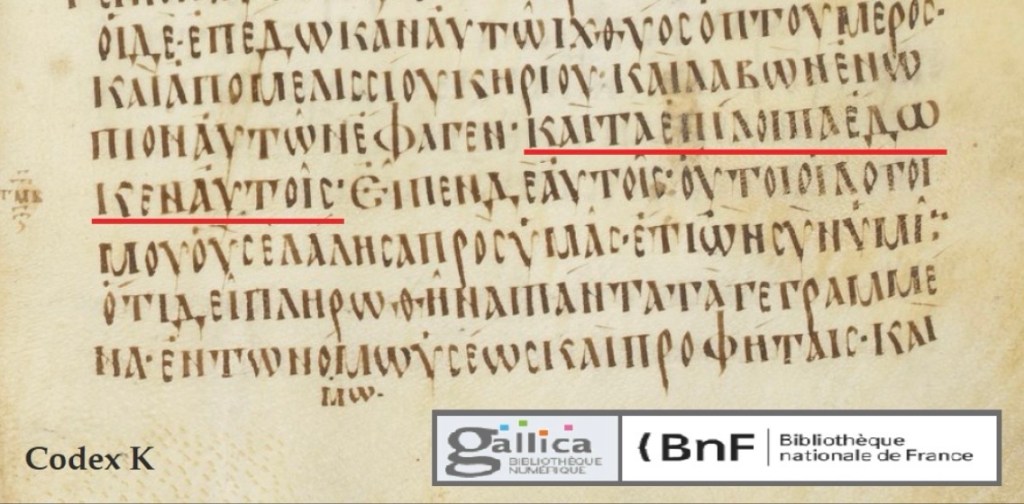
Extra words appear in the text of
Luke 24:43 in Codex K.
● In Luke 24:43, after the usual statement that Jesus “took and ate in their presence,” several significant manuscripts – including K, Θ, Π*, and members of f13, as well as the Vulgate and, according to Tregelles, the Curetonian Syriac and the Armenian and Ethiopic versions, also say, “and gave the rest to them.” (Θ does not include “and.”) This phrase may have been added when and where the passage had been interpreted somewhat mystically – the fish in the narrative being seen as congruent to the presence of Christ, ΙΧΘΥΣ – and when this point was reached in the Scripture-reading in the worship-service, the celebration of the Lord’s Supper commenced.
● In Luke 24:36, after Jesus’ appearance in the midst of the disciples, He says to them, “Peace to you!” In a small number of Greek manuscripts (including uncials G and P), and in the Vulgate, Jesus says a bit more; He goes on to say, “It is I; do not be afraid.” These extra words – drawn from John 6:20 – are supported, according to the UBS apparatus, by the Vulgate, the Peshitta, the Harklean Syriac, the Armenian version, and by Ambrose and Augustine (in Contra Felicem Manichaeum). In addition, in Codex W, “It is I; do not be afraid” appears before “Peace to you.”
All these witnesses may echo early Easter-time liturgical arrangements of the blended-together Gospel-accounts. An early attempt to remove the intruding words appears to have gone too far; in several Old Latin manuscripts and in Codex Bezae, the entire phrase – “and said to them, “Peace to you” – is missing. (This is one of the “Western Non-interpolations” which appear in Luke 24.) Another possibility is that the phrase was skipped by accident.
The worship-services of the early churches had a detectable impact upon the text of the New Testament. But the impact of the text of the New Testament upon the early churches was far greater. As far as the use of the words, “in the name of the Father, and of the Son, and of the Holy Spirit,” are concerned, there was one reason for the early Christians to use these words: they were attributed to Christ in every copy of the Gospel of Matthew.
 albanianchristianity

Leave a comment